
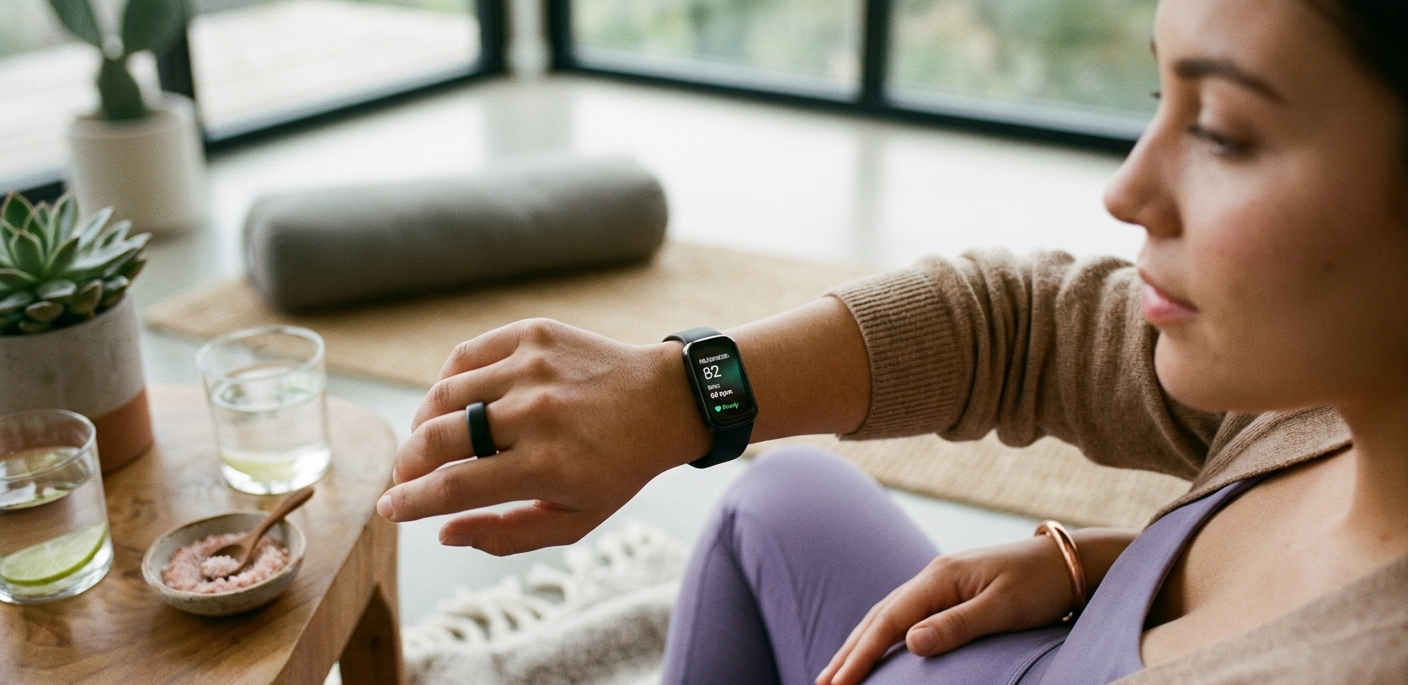
This year, parents are behaving like detectives who are always tracking the daily data of their kids’ activity. Modern gadgets and wearables such as Oura rings, Whoop bands have helped them track their daily sleep activity, steps taken each day, stress levels, and now their wrist’s “readiness score”. How to utilize your heart rate data to enhance your yoga practice? Once you figure out the numbers, they can be a phenomenal tool in aiding your yoga practice. When you combine your digital biometrics with traditional naturopathy, you will no longer need to perform generic routines. You will be able to perform a custom-tailored routine based upon your current body’s needs today.
First, there needs to be an understanding of how your resting heart rate (RHR) translates into readable data for you to be able to create a comprehensive wellness program. What the Readiness Score Represents?
Most wearable devices provide a user-defined “readiness score” (0-100 scale). It is based on selected biometrics collected from your body [RHR, heart rate variability (HRV), sleep quality and recovery metrics]. RHR is your baseline of heartbeats each minute while at rest. It is the most indicative and important measurable indicator of data. It applies to your body and to the autonomic nervous system.
Customize Your Yoga with RHR as a Resource
Forget cookie-cutter workouts. Utilize RHR to customize your routine according to what your body needs, allowing you to harness the restorative effects of yoga through nature’s way.
When Your RHR Stays Consistent (RHR score of 80+)
Your body is on standby for movement. Choose to practice Vinyasa Flow – a flowing sequence of postures where movement and breath sync together to increase temperature and build strength.
A 20 Minute Work Out: Begin with Surya Namaskara (Sun Salutation), move into Warrior II to Plank, move into a twisting position with Revolved Triangle and finish with a supported bridge for hip opening.
Why This Is Effective: The consistency of your RHR means that your heart rate variability (HRV) is able to handle the added stimulus of cardiovascular work which increases blood flow and endorphin production without causing excessive stress on your system.
When RHR is High (Low Readiness: Score Less Than 60)
To recover using Yin Yoga: slow, passive holds that will target your deepest connective tissues.
A sample of a 20-minute session would look like this:
5 minutes in supported child’s pose–> 5 minutes side of Dragonfly (wide-legged forward fold) –> 8 minutes Legs-up-the-wall pose. Use props such as bolsters/blankets to ensure your yoga practice is totally free of strain.
Reasons why this Sequence Works? When RHR is elevated, it indicates that the body is experiencing sympathetic dominance (fight or flight). By putting gentle pressure on the body, it activates the parasympathetic nervous system (recovery mode), thus lowering RHR.
Pro Tip: Record your RHR after your yoga sessions over time. This helps identify trends, including how fast Vinyasa lowers your RHR on days when you are more stable.
Naturopathy’s use of biofeedback and hydration to create a state of whimsical energy and motivation. This can lead to increased readiness (as evidenced by an increase in RHR and decrease in HRV). Hydration has been scientifically shown to suppress stress caused by dehydration. Using an electrolyte infusion can provide rapid relief from dehydration stress using natural resources.
To experience the rapid reinstatement of hydration for pre-yogic activities,try this-
- Mix 1 cup of coconut water with a pinch of Himalayan sea salt.
- Squeeze of fresh lime juice or lemon juice in a drinking container.
- Consume prior to your yoga practice to benefit from the potassium and natural sugars that coconut water contains. This replaces fluids without going into sugar crashes.
Adding 1/4 teaspoon of sea salt to 16 ounces of water and fresh lemon will help compensate for the high levels of stress as indicated by elevated cortisol levels. The salt acts as a counterbalance to sodium-potassium pump ratios, sending your adrenals a signal to relax.
These methods have their basis in naturopathic principles of hydration being the basis for vitality, and you can track how hydration improves your overall readiness by measuring your readiness upon waking after utilizing one of these methods.
For Working Parents to Create New Routines:
Please use your wearable technology as an accountability tool. Start with 6 AM checks, select a yoga type, and then do yoga for at least 20 minutes after hydrating/lubricating appropriately. After doing all the above for 30 days, you should experience an improved RHR (resting heart rate), better sleep, and greater patience with general family chaos. The wearable provides the data; naturopathy provides the knowledge – together they will help you to thrive through the ride of data overload entering 2026.
Read AI Ovulation Tracking apps Accuracy here.

AI and healthcare is a disaster!
I think it is not if judicially used… but then, you cannot trust machines!